
One stop or two in F1? The boring one nearly always wins
The boring strategy, the one most of the field copies, nearly always wins: in 66 of 70 dry races the winner made the most common number of stops. Here is how many that is, and what happens to anyone who strays.

Photo: Mohd Nor Azmil Abdul Rahman , CC BY 2.0

Written by Andrés Rendón
Founder and host of Somos Motor, November 21, 2026
The boring strategy nearly always wins: the one most of the field copies. In 66 of the 70 dry races from 2023 to 2026, the winner made the most common number of stops on the grid. And nobody won on a stop count that fewer than a quarter of the finishers shared.
Lando Norris is one of the four exceptions. He won the 2026 Hungarian Grand Prix on three stops when the pack made two, and even then just over a quarter of the finishers had done the same.
Three things to say at the next race:
- Half of all winners stopped once. Two stops, four in ten; three, fewer than one in ten.
- A safety car adds a stop. Winners averaged 1.64 stops with one, against 1.40 without.
- Stopping more usually means finishing worse, though that does not prove the stops are to blame. Among team-mates on different strategies, the one who stopped less finished ahead in two cases out of three.
01Winners' stops at a glance
| Winner's stops | Races | With a safety car or VSC (of 50) | Without (of 20) |
|---|---|---|---|
| One | 36 (51%) | 24 | 12 |
| Two | 28 (40%) | 20 | 8 |
| Three | 6 (9%) | 6 | 0 |
Only dry races without a red flag count.
02One stop, half the time
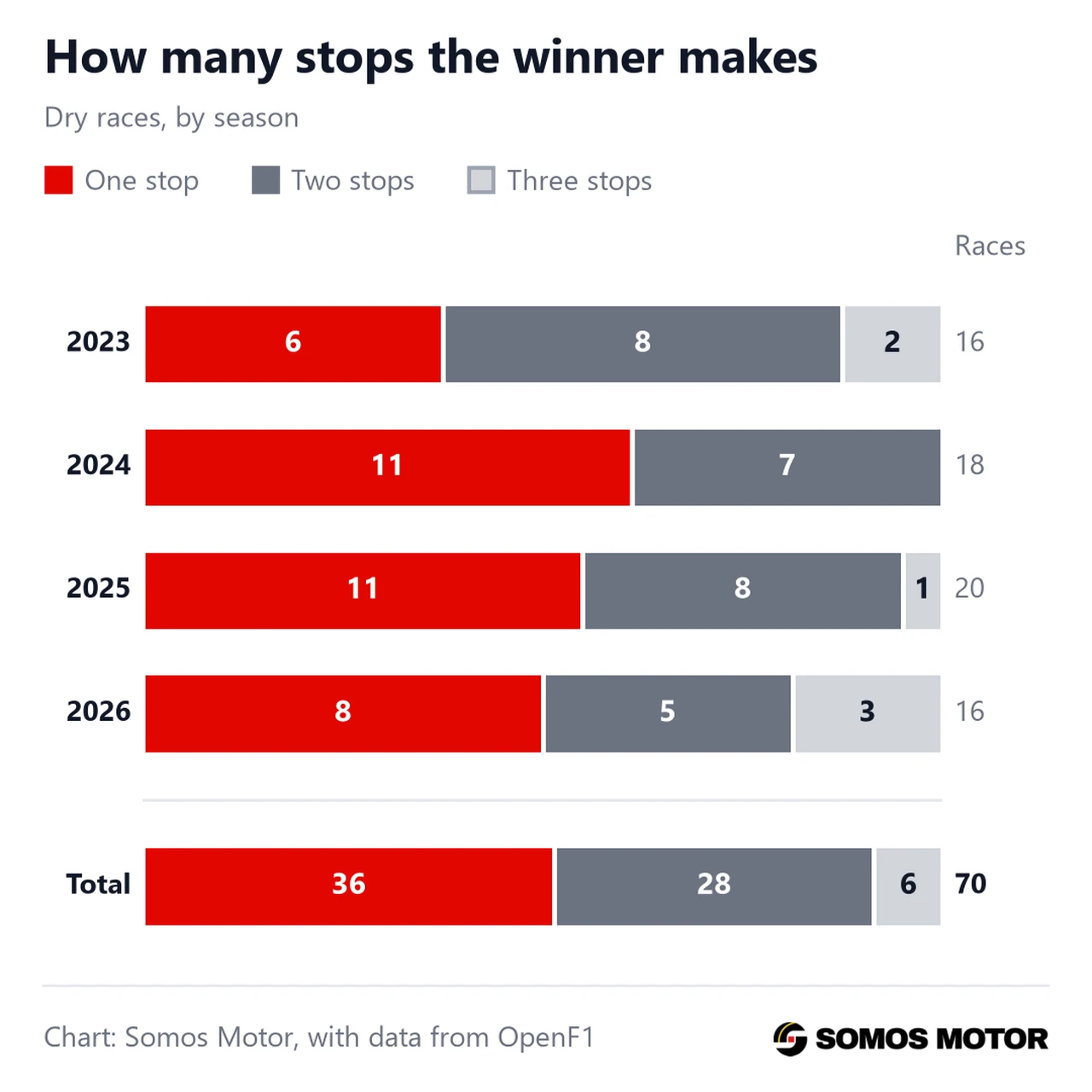
Every season looks alike: one and two stops take almost all the wins, and three stops have won just six races in four years. Only 2023 tilted towards two.
03The winner copies the field
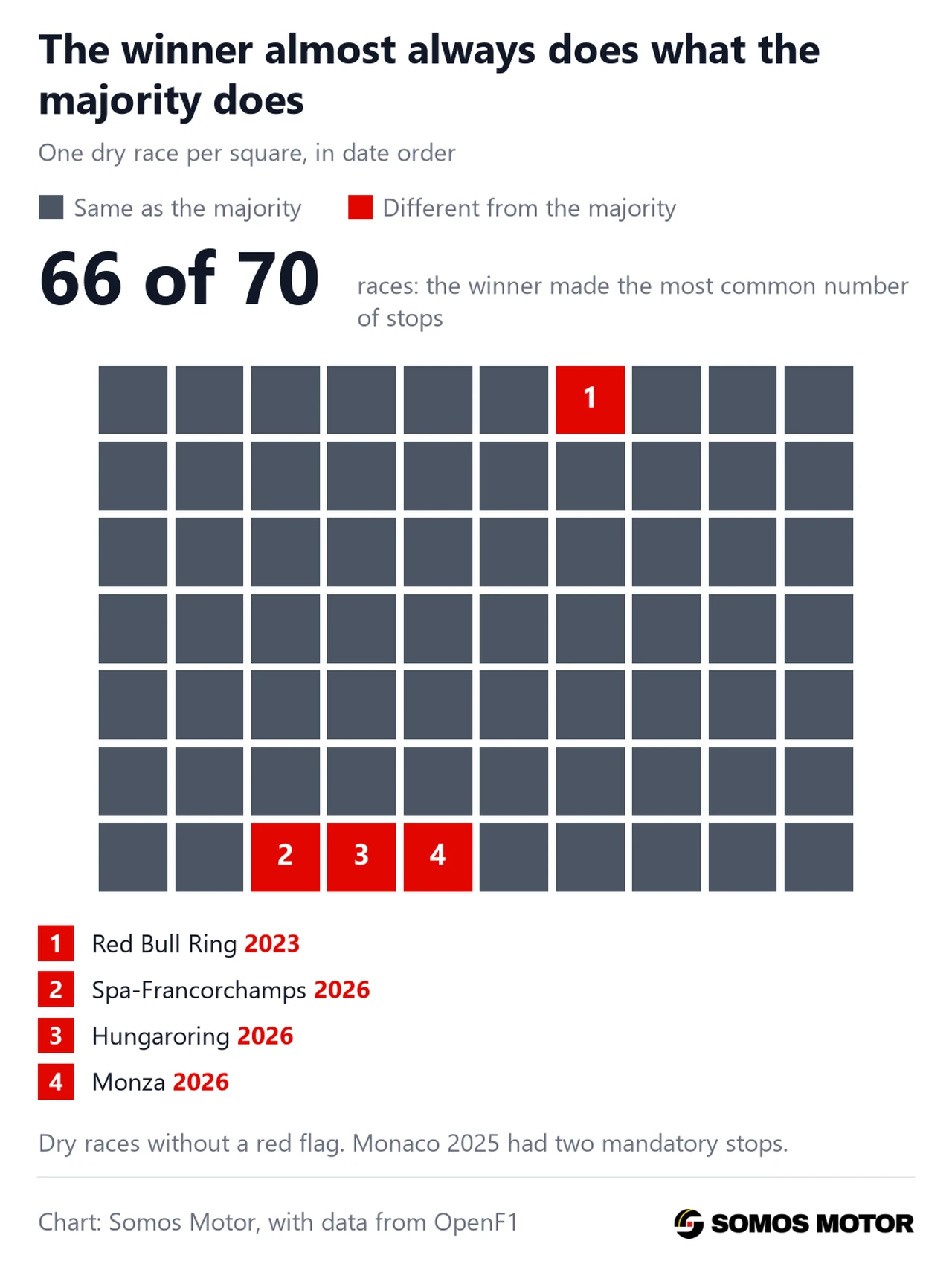
Boring here means normal: the number of stops most drivers made in that race. In 66 of 70 the winner matched it. The four exceptions were hardly lone gambles, because between a quarter and almost half of the finishers shared their stop count. They were Max Verstappen at the 2023 Austrian Grand Prix and, all in 2026, Kimi Antonelli at Spa and Monza and Norris in Hungary.
04A safety car adds a stop
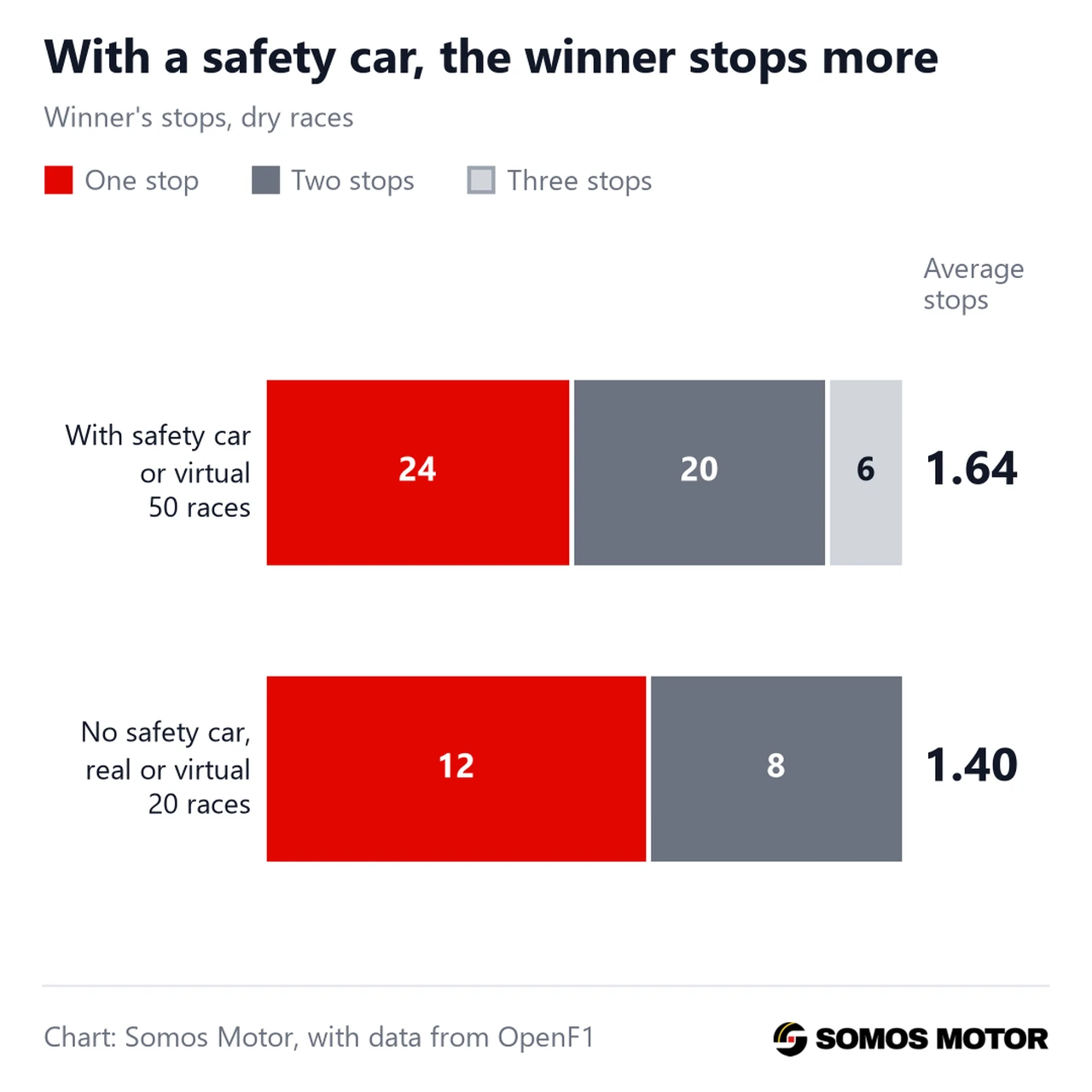
When a safety car or virtual safety car comes out, the winner stops more: 1.64 times on average, against 1.40 without one. Six of the 50 races with an interruption went to a three-stopper, and none of the 20 without. That is what you would expect, but we measure what happened, not why.
05Stopping more usually means finishing worse
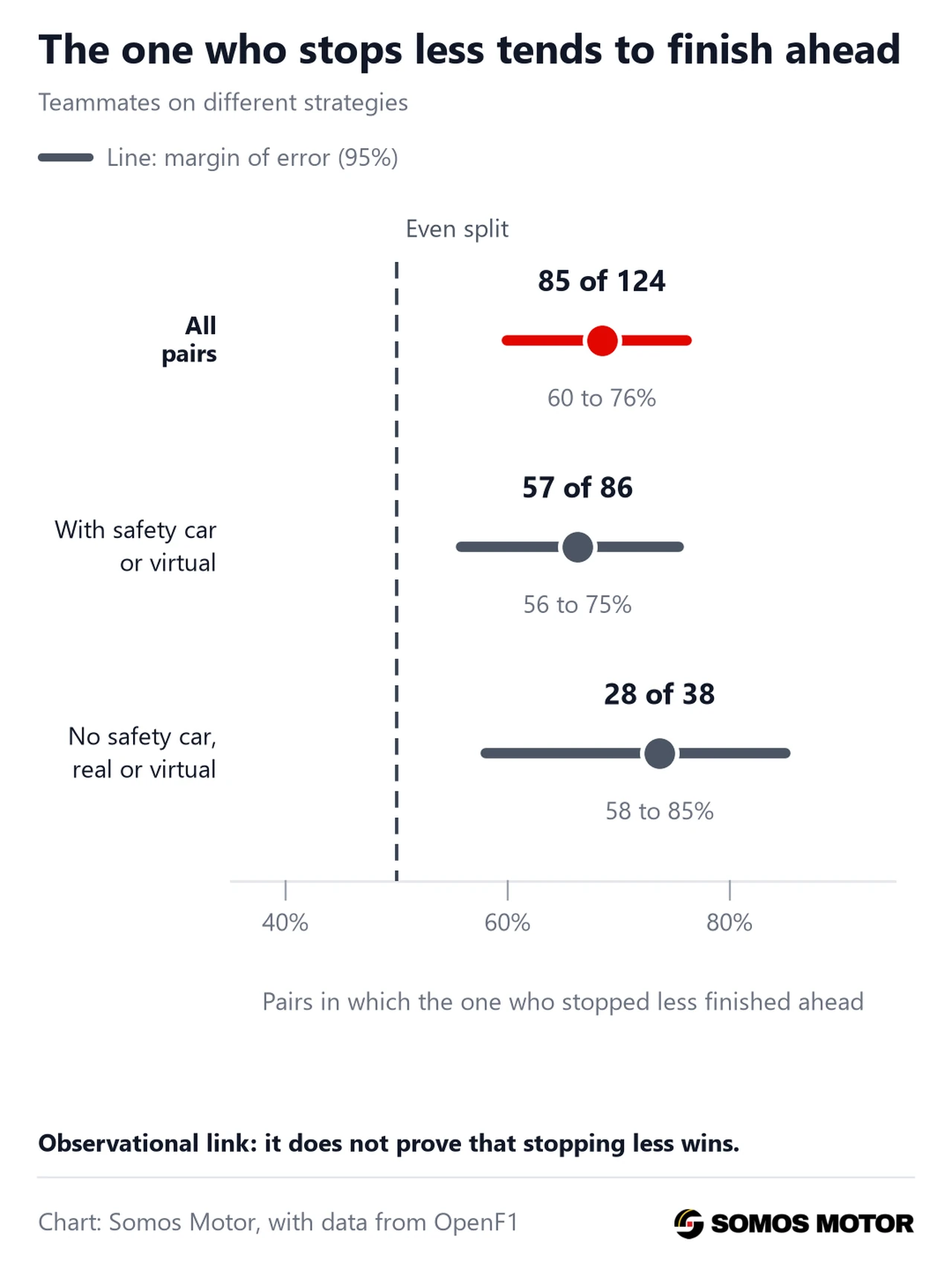
Among team-mates on different strategies, the one who stopped less finished ahead in 85 of 124 cases, or 69%. The grid does not explain it: the driver who stopped less had started ahead only half the time. One stop more than the field goes with about two places lost at the flag, while stopping less cannot be told apart from zero.
At Spa in 2024, Verstappen climbed from 11th to fourth on two stops, while Sergio Pérez, on three, slid from second to seventh. Abu Dhabi in 2025 went the other way: Nico Hülkenberg rose from 18th to ninth on two stops, ahead of Gabriel Bortoleto, who made one and finished 11th.
None of this proves that gambling never pays. Drivers who stop more are often struggling already, through damage, traffic or a car without pace, and this data cannot separate that cause from the effect. What can be said is that in 70 races nobody won on a lone gamble.
06Does each circuit have its own strategy?
Not yet: no circuit reaches the six dry races we asked for, and the most is four. What we have are hints from recent years, not rules. Baku, Jeddah, Miami and Singapore have always been won on one stop, and Sakhir on two.
072026: the rule bends a little
Three of the four exceptions came in 2026: the winner matched the field in 13 of 16 races, against 53 of 54 in the three seasons before. It is a new rulebook and a new range of tyres, and Pirelli has said it wants races that mix one and two stops. With 16 races we cannot say whether this is a change or a run. The three left, Las Vegas, Lusail and Abu Dhabi, will show whether the majority still wins.
08What is behind the measure
The data come from OpenF1, for 2023 to 2026. A stop is a pit entry with a change of tyres, and the field's strategy is the most common number of stops among the classified finishers of each race, whatever the compounds. Only Sunday races without rain or a red flag count: 70 of the 90 with data.
According to Motorsport.com, Monaco 2025 had two compulsory stops, and without it the figure is 65 of 69. The comparisons between drivers control for the grid and are not proof of cause. If you are starting from scratch, read how Formula 1 works and the F1 glossary: they cover everything above.
Frequently asked questions
Is one stop or two stops better in F1?
Neither is better in itself: the winner is usually the driver who does what most of the field does that day. From 2023 to 2026 the winner made one stop in 36 of 70 dry races and two in 28. It depends on the circuit, the tyres and what happens in the race.
How many pit stops does an F1 winner make?
One in 51% of dry races, two in 40% and three in 9%. With a safety car or virtual safety car, winners stop more: 1.64 times on average, against 1.40 in races without either.
Do more pit stops mean a worse result?
They go with a worse finish: one stop more than the field is worth about two places fewer at the flag. That does not prove the stop is the cause, because drivers who are struggling already tend to stop more.
Which strategy wins at each F1 circuit?
We cannot say yet: no circuit has the six dry races we asked for, and the most is four. In recent years Baku, Jeddah, Miami and Singapore have always been won on one stop, and Sakhir on two.
Why are there more exceptions in 2026?
Three of the four races won on a strategy different from the field are from 2026, a season with a new rulebook and a new range of tyres. With 16 races it is too early to say whether this is a change or a run.
Keep reading
More from the blog

November 23, 2026
Red Bull has lost its F1 pit lane crown
Red Bull was quickest through the pit lane in 2023 and 2024, then slipped back to the pack in 2025. Who took the crown, and who is stuck behind the median every year?

November 22, 2026
Ollie Bearman still unsigned at Haas as the F1 2027 grid takes shape
Haas insists Ollie Bearman will race for them in 2027, but there is still no signed contract. Here is where every other seat on the F1 2027 grid stands.

November 22, 2026
Perez gets five-place grid penalty for Qatar GP
The stewards found Sergio Perez wholly to blame for the Las Vegas clash with Rafael Camara. His unserved 10 seconds become a grid drop in Qatar.