
How much does a MotoGP bike cost? You can't buy one, and teams lease them for a reported €2m to €4m
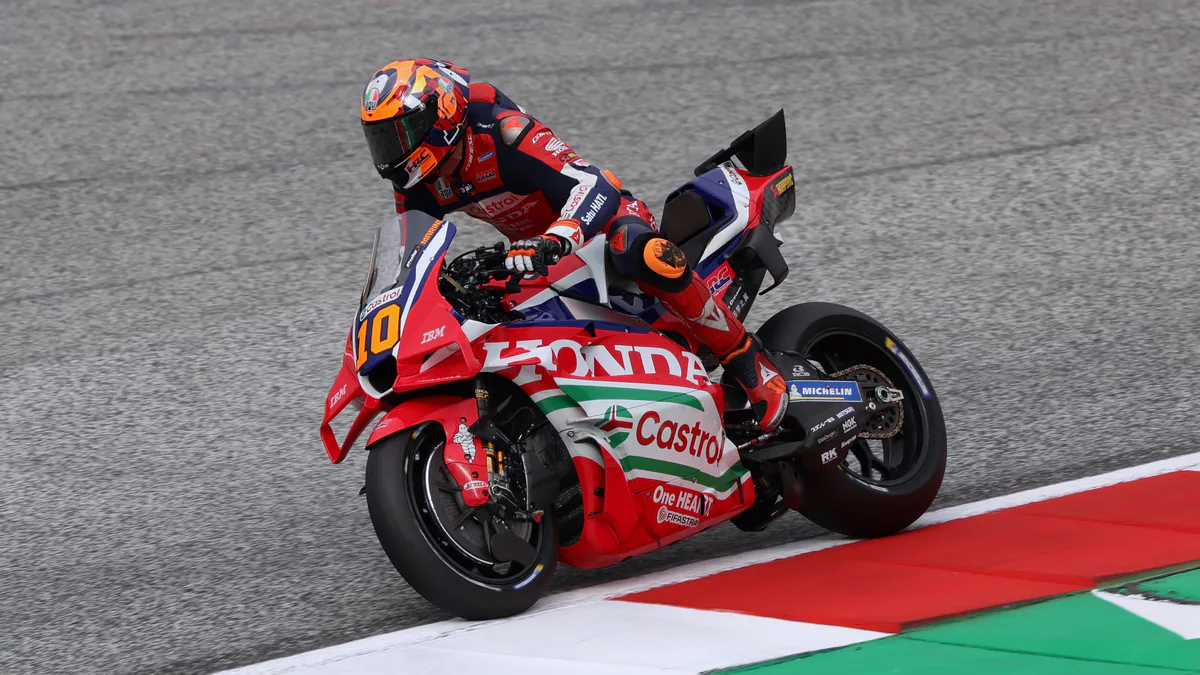
You can buy a Ferrari, but not a MotoGP bike. They are prototypes that satellite teams lease from the factory, and the figures in circulation run from €2m to €4m a season. Here is what is known about engines, tyres and budgets, and which road bike comes closest.

Photo: TeamEG00 , Public domain

Written by Andrés Rendón
Founder and host of Somos Motor, November 1, 2026
You can buy a Ferrari, a Lamborghini and even a 1990s Formula 1 car at auction. What you cannot buy, however much money you bring, is a MotoGP bike. It is not for sale. And the reason is not just the price: the regulations are designed so that no market exists.
Even so, the money involved is real. And although nobody publishes an official invoice, some figures do circulate, always with an owner behind them. We set them out here on one condition: every market figure is attributed to whoever published it and is indicative. No source, no figure.

01Why it is not for sale: they are prototypes
MotoGP is a prototype category. The championship's own website says so: riders compete on “prototype motorcycles”, with a minimum weight of 157 kg. Each manufacturer builds its own purely to race, without deriving it from any road model, and that leaves it out of any dealership catalogue. If you want to understand what separates that bike from a Moto2 machine or a Superbike, we explain it in how MotoGP works and in the differences between MotoGP and Superbikes.
What does exist is an internal market, between factories and teams. The brands with their own team (the so-called factory teams) use their bikes directly. Satellite teams, which are independent outfits, do not buy them: they lease them from a manufacturer each season. More on how those roles are shared out in the 2027 grid.
02What it costs to lease one: what has been published
Take these with a pinch of salt, because the contracts are private and the figures that emerge are leaks or journalists' estimates. These are the most quoted:
- €2.2 million for leasing the bikes from a manufacturer, according to Crash.net in 2023, citing Speedweek.
- Up to €2 million per rider per season for a complete bike, according to Box Repsol (no source stated).
- From €2 million (older material) to €4 million (a competitive package), according to The Race in 2020, citing anonymous team bosses.
Note that they do not agree, and that is normal: they depend on the specification leased (a recent package is not the same as one from two years ago), on how many parts and how much technical support are included, and on the year. Treat them as an order of magnitude: between €2 million and €4 million a season, according to those sources, not as a tariff.
There is a counterweight that is almost never mentioned. According to Crash.net, Dorna, the company that runs the championship, pays each manufacturer €1 million for every bike supplied to a satellite team, although it only rewards one per brand (to Yamaha, which had no satellite team that year, it gave €500,000). It also subsidises the teams themselves with between €6.5 million and €7 million a year. The lease exists, but the championship partly subsidises it.
03What an engine costs and how many you can use
The engine is the most expensive part of the bike and the most closely policed. According to Box Repsol, a top-class engine costs between €200,000 and €250,000. It is an estimate with no specific attribution, but it fits the order of magnitude quoted in the paddock.
What is official is the limit. According to MotoGP.com, the regulations set a baseline of seven engines per rider per season. With calendars of 21 or 22 races, like 2026, that cap rises to eight, according to Autosport. And there is a system of concessions: the lowest-ranked manufacturers can use nine or ten engines and get more testing days as compensation. For 2027 the general limit drops to six (seven with calendars of 21 or 22 Grands Prix), according to Crash.net, one of the cost-containment measures of the new regulations.
Engine capacity changes too. Until 2026 the bikes are 1,000 cc. In 2027 they move to 850 cc, a change that forces every manufacturer to develop a new engine. That is when the cost is most noticeable: each brand has to invest in an engine that it will then have to freeze for years.
04Tyres: a single supplier and a quota per rider
In MotoGP you do not buy tyres on the open market: they are supplied by a single supplier, which until the end of 2026 is Michelin. According to MotoGP.com, each rider has 22 slick tyres per weekend (10 front and 12 rear) and 13 wet tyres (6 and 7). Dorna announced in March 2025 that Pirelli will be the sole supplier from 2027, on a contract running to 2031 according to Crash.net.
What do they cost? There is no list price, and that is the point: teams receive the rubber as part of the agreement between Dorna and the supplier. One figure that does circulate, from Box Repsol, says Michelin spends more than €1.2 million at each Grand Prix, but it does not say where it comes from. We use it only as a reference for the scale of the operation, not as the price of a tyre. If you want to understand why that rubber decides so many races, we go through it in the MotoGP glossary.

05What a whole season costs
The ranges here are wide. According to The Race, which in 2020 asked satellite team bosses who asked not to be named, the budget of a team like that is somewhere between €10 million and €15 million a year, and they put spare parts alone at around €6 million. For factory teams we have not found a figure attributable to a reliable source, so we do not give one: no source, no figure.
It is worth remembering what we are talking about: the bill for a season includes staff, travel, spares, crashes and the riders' wages. The bike is only one part. According to Box Repsol, a minor crash can cost between €15,000 and €20,000 in repairs and a serious one around €100,000.
06The closest thing you can actually buy
If what you want is a bike with MotoGP DNA, there are three routes, and all three are legal and come with a number plate.
- Ducati Desmosedici RR (2006-2008). The road replica of Ducati's MotoGP bike: a 989 cc V4, around 200 hp according to the manufacturer and 1,500 units. According to Motorpasión Moto, it cost €60,000 and sold out before the end of 2007. Used examples turn up today at very different prices depending on condition and mileage: according to listings picked up by the specialist press, they have changed hands from about €50,000 to more than €100,000.
- Honda RC213V-S (2015). The road bike closest to the racing RC213V. According to Motociclismo, it launched at €191,000 in Spain and made 159 hp, rising to 215 with a track kit costing between €12,000 and €13,000. It is probably the closest a private owner has come to a MotoGP bike.
- A current superbike. The gap to MotoGP is wide here, but so is the price gap. The Ducati Panigale V4 R, for example, launched in 2018 at €39,900 in Spain, according to Diariomotor. It has a 998 cc engine and takes its cues from what is done on track, although it has nothing to do with a racing prototype.
These are not MotoGP bikes, and it is important to say so plainly: they are road products that share an idea, an architecture or an image. To take a real one home, you would have to be a manufacturer.
07The sums in four lines
- A MotoGP bike is not sold: it is a prototype and satellite teams lease it from the manufacturer.
- Published lease figures run from €2 million to €4 million a season, depending on the source and the package. They are indicative.
- Engines are limited by the regulations: seven per rider per season as a baseline, eight with a calendar as long as 2026's, and the cap drops in 2027, when capacity falls to 850 cc.
- The closest thing you can buy is road replicas such as the Desmosedici RR or the RC213V-S, now collectors' items.
All the money figures in this article come from media reports and published estimates, not from official team documents, and are quoted as of October 2026. The regulation data (engines, capacity, tyres) is verified on MotoGP.com and in the championship's official information.
Frequently asked questions
Can you buy a MotoGP bike?
No. They are prototypes that each manufacturer builds purely to race, and they are not for sale. Satellite teams do not buy them: they lease them from the manufacturer each season.
How much does it cost to lease a MotoGP bike?
There is no public price list. According to Crash.net (2023, citing Speedweek), leasing from a manufacturer is around €2.2 million, and according to The Race (2020, anonymous sources) it runs from €2 million to €4 million depending on the package. These are indicative figures.
How many engines can a rider use in a season?
The baseline in the regulations is seven per rider per season, according to MotoGP.com, and eight when the calendar has 21 or 22 races, as in 2026, according to Autosport. For 2027 it is due to drop to six, according to Crash.net. Manufacturers with concessions can use nine or ten.
Which road bike is closest to a MotoGP bike?
The 2015 Honda RC213V-S (€191,000 in Spain according to Motociclismo) and the 2006-2008 Ducati Desmosedici RR (€60,000 according to Motorpasión Moto). They are road-going replicas, not the racing bikes.
What engine capacity do MotoGP bikes have?
1,000 cc until 2026. In 2027 they move to 850 cc, under the regulations announced by MotoGP.
Sources
- What are the MotoGP Rules? (motores, cilindrada, neumáticos, concesiones)
- Revealed: How much money Dorna gives to MotoGP's satellite teams
- MotoGP confirms 2027 regulations - here they are
- How much does it really cost to run a MotoGP team?
- How much does a MotoGP cost?
- MotoGP alters engine allocation for expanding calendars
- Official: MotoGP announces major new tyre supplier Pirelli 2027
- Vendidas las 1.500 Ducati Desmosedici RR
- Presentada la nueva Honda RC213V-S: precio y datos técnicos
- Este es el precio de la Ducati Panigale V4 R
Keep reading
More from the blog

November 18, 2026
Ogura leaves Trackhouse and Aprilia for Yamaha: contract to 2028 with Martín as team-mate
Yamaha announced on 1 July 2026, three days after his first win at Assen, that Ai Ogura will be a factory rider in 2027 and 2028. What is known about his move from Aprilia to Yamaha and who takes his seat at Trackhouse.
November 17, 2026
Tech3 KTM has its 2027 pairing: Marini leaves Honda and Agius steps up from Moto2
Tech3 KTM completed its 2027 line-up with Luca Marini, announced on 26 August, and Senna Agius, on 16 September. How each arrives, who leaves the team and what the multi-year deal Tech3 and KTM signed in May says.

November 17, 2026
MotoGP Fan Fest in Valencia: free to enter, but register first
Rider sessions, simulators and live race screenings at Valencia's City of Arts and Sciences from 25 to 29 November. Entry is free with a QR code; the Marina Sur concerts are a separate, ticketed event.