
MotoGP explained for beginners: points, sprints, tyres and the 2027 rules
MotoGP makes sense in ten minutes. What it is, how points are won, why there is a race on Saturday and another on Sunday, why tyres matter so much and what changes in 2027. A beginner's guide from scratch.


Written by Andrés Rendón
Founder and host of Somos Motor, June 13, 2026
MotoGP in four facts (according to MotoGP.com):
- Sunday race: 40 to 43 minutes, roughly 110 to 120 kilometres depending on the circuit.
- Saturday sprint: about half the laps, around 20 minutes.
- Points: the race winner scores 25 and the sprint winner 12. The top 15 score on Sunday and the top nine on Saturday.
- Maximum per weekend: 37 points (12 for the sprint plus 25 for the race).
If you have ever sat down to watch a MotoGP race knowing nothing about it, getting lost is perfectly normal: there is a race on Saturday and another on Sunday, the points change, and suddenly everybody is talking about tyres as if nothing else mattered. Don't worry. MotoGP makes sense in ten minutes, and once it clicks, no sport is more addictive. Here is the beginner's guide: what it is, how you win and why it hooks people so badly.
01What MotoGP is in one sentence
MotoGP is the top class of motorcycle world championship racing: the Formula 1 of bikes. These are one-off prototypes, bikes you can't buy at any dealership, built by manufacturers such as Ducati, Yamaha, Honda, Aprilia or KTM purely to race. Elite riders fight for the title over a season that circles the globe.
Below MotoGP there are two more classes that race the same weekend, with younger riders working their way up: Moto2 and Moto3. They are the feeder classes. Almost every MotoGP great came through them.
02The analogy that explains it in 10 seconds
Think of a football league. It isn't settled in a single match: a round of games is played every week, each result earns points, and at the end of the season the side with the most points is champion. MotoGP works the same way, but instead of matches there are races (Grands Prix) spread around the world, and instead of teams of eleven, a rider and a bike.
03What a race weekend looks like
Each Grand Prix lasts three days and has two races, not one. This is what throws newcomers most:
- Friday: practice. Riders try out the bike and the tyres, and sort out who goes straight through to the fight for pole.
- Saturday: first qualifying (it sets the starting order, the "grid"), then in the afternoon the sprint: a short race at half distance, fast and attacking.
- Sunday: the full-distance race, the big one, the one that hands out the most points.
So a rider can score on Saturday in the sprint and again on Sunday in the race. Two chances every weekend.
And how long does each one last? According to MotoGP, the Sunday race takes 40 to 43 minutes, roughly 110 to 120 kilometres depending on the circuit. The sprint covers around half the laps and is over in about 20 minutes.

04How points are won (the heart of the championship)
This is the key to everything. In every race, the leading riders take points according to where they finish. The more races go by, the further the championship leader pulls clear.
In the full-distance race on Sunday the top 15 score:
- 1st: 25 points
- 2nd: 20
- 3rd: 16
- 4th: 13
- 5th: 11
- 6th to 15th: 10, 9, 8, 7, 6, 5, 4, 3, 2 and 1 point.
In the sprint on Saturday only the top nine score, and for less:
- 1st: 12 points
- 2nd: 9
- 3rd: 7
- 4th to 9th: 6, 5, 4, 3, 2 and 1 point.
Add the two together and a rider can take a maximum of 37 points in a single weekend (12 from the sprint plus 25 from the race). Whoever has the most points when the season ends is the world champion.
05How many races are in a season
The 2026 season has 22 Grands Prix on five continents. It opens in Thailand in late February and ends in Valencia in November. In between it visits legendary venues such as Jerez, Mugello, Assen and Phillip Island. It is one of the longest calendars in the history of the championship.
06Why tyres matter so much
Watch a race and you will hear about tyres non-stop, and with good reason. Every rider runs the same tyres (a single supplier for everybody), and choosing well between the soft compound (more grip but it wears out sooner) and the hard (it lasts longer but grips less) can win or lose a race. A MotoGP bike has so much power that, without the tyre in its sweet spot, nobody can control it. Managing that rubber over the whole race is half the secret of success.
07What nobody tells you: electronics and aerodynamics
A MotoGP bike isn't just a ferocious engine and a brave rider. It is a beast packed with technology:
- Electronics: traction control, launch control, engine maps. The rider adjusts things on the move using buttons on the handlebars. It's nothing like your road bike: here the electronics decide how much of all that power reaches the ground without the wheel spinning.
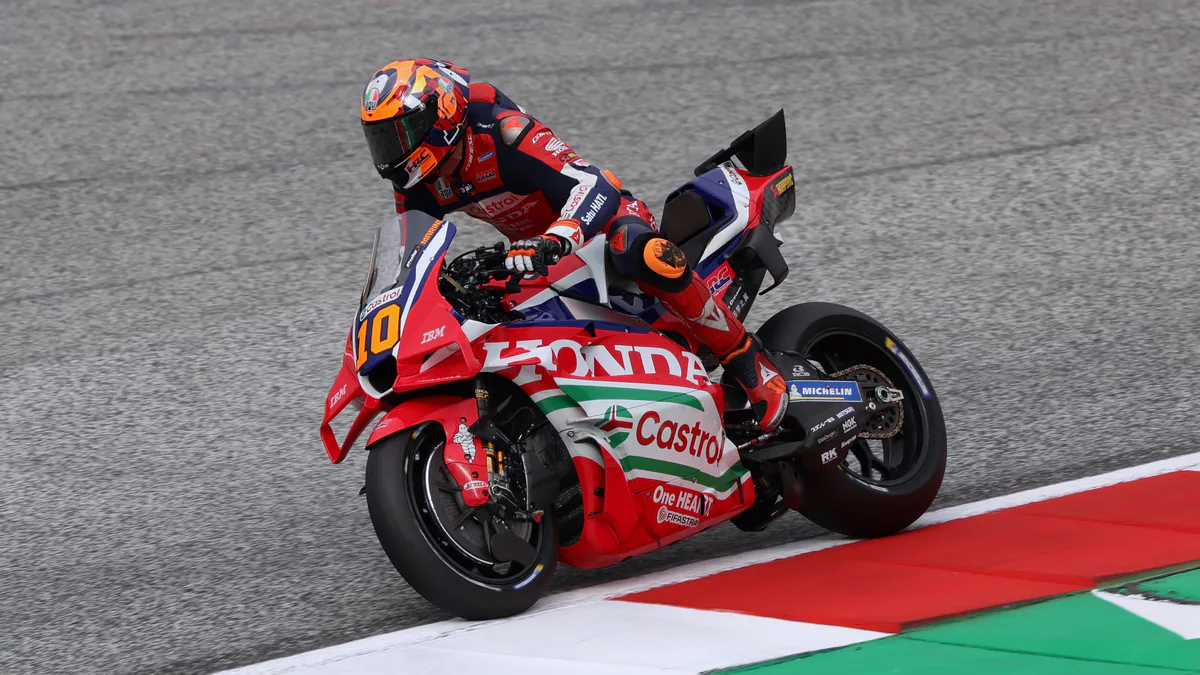
- Aerodynamics: those "wings" you see on the fairing are not decoration. They generate downforce so the bike doesn't wheelie at full acceleration and sticks better to the tarmac. Aerodynamics has become so important that it is one of the great battlegrounds between manufacturers.

08Look ahead to 2027: MotoGP changes the rules
If you start following now, a big change is coming. From 2027 the technical regulations change to make the bikes a little less extreme and more evenly matched:
- Engines drop from 1,000 to 850 cubic centimetres (less capacity, a little less raw power).
- Devices that lower the bike under acceleration and at the start are banned (the so-called ride-height and holeshot devices), which today give a huge advantage.
- Aerodynamics are cut back: a narrower front fairing and more tightly controlled rear aero.
- Bikes will run on 100% sustainable fuel with smaller tanks.
The calendar for that first season, with its 22 rounds, is already public: you can find it in MotoGP 2027: calendar and teams. What is all this for? To curb an escalation in technology and cost that was spiralling, and to try to make the racing closer. Some read the shift as a correction of the last fifteen years: we go through it when checking the figures on MotoGP's audience decline. It is a great time to get hooked: you will see the end of one era and the start of another.
09Where to start watching
You don't need to understand everything on day one. Put a race on, look at who leads the championship, and enjoy the overtakes in the last laps, which is where the magic is. After a couple of Grands Prix you will be checking the points and have a favourite rider. And if words like holeshot, highside or long lap penalty slip past you on the broadcast, they are explained one by one in the MotoGP glossary.
And if you are wondering how all this differs from the World Superbike Championship, the other big circuit-racing series for bikes, we compare them in MotoGP or Superbikes: how they really differ.
To see how tough that grid is, take a recent case: Álex Rins retires at 30 after fourteen seasons and six wins, because he couldn't find a seat for 2027.
Getting to the top is another story, and we tell it with someone who trains riders: Álex Rubio, of RARO Riding School.
On the Somos Motor podcast we love the world of racing and everything behind a bike pushed to the limit. If you want to keep learning about motorsport, have a look at our episodes and we will let you know about every new one in the newsletter.
Frequently asked questions
Why are there two MotoGP races each weekend?
Since 2023 every Grand Prix has a sprint on Saturday (short, at roughly half distance) and the full race on Sunday. The sprint hands out fewer points; Sunday is the main event. A rider can score in both.
How many points do you get for winning a MotoGP race?
Winning the Sunday race earns 25 points; winning the Saturday sprint earns 12. The maximum for one weekend is 37 points. Whoever has the most at the end of the season is world champion.
What is the difference between MotoGP, Moto2 and Moto3?
They are three classes that race the same weekend. MotoGP is the top class, with the most powerful prototypes and the best riders. Moto2 and Moto3 are the feeder classes, with less powerful bikes and younger riders hoping to move up to MotoGP.
How many races are there in a MotoGP season?
The 2026 season has 22 Grands Prix on five continents, from late February (Thailand) to November (Valencia). It is one of the longest calendars in the history of the championship.
Can you buy a MotoGP bike?
No. They are one-off prototypes, built by the manufacturers purely to race, and they are not sold. The closest you can buy are the road-going sports versions inspired by them, but it isn't the same thing.
How long is a MotoGP race?
The Sunday race lasts 40 to 43 minutes, roughly 110 to 120 kilometres depending on the circuit. The Saturday sprint covers about half the laps and takes around 20 minutes.
Keep reading
More from the blog

November 18, 2026
Ogura leaves Trackhouse and Aprilia for Yamaha: contract to 2028 with Martín as team-mate
Yamaha announced on 1 July 2026, three days after his first win at Assen, that Ai Ogura will be a factory rider in 2027 and 2028. What is known about his move from Aprilia to Yamaha and who takes his seat at Trackhouse.
November 17, 2026
Tech3 KTM has its 2027 pairing: Marini leaves Honda and Agius steps up from Moto2
Tech3 KTM completed its 2027 line-up with Luca Marini, announced on 26 August, and Senna Agius, on 16 September. How each arrives, who leaves the team and what the multi-year deal Tech3 and KTM signed in May says.

November 17, 2026
MotoGP Fan Fest in Valencia: free to enter, but register first
Rider sessions, simulators and live race screenings at Valencia's City of Arts and Sciences from 25 to 29 November. Entry is free with a QR code; the Marina Sur concerts are a separate, ticketed event.