
F1 teammate head to head says less than you think
Inside a pairing the head-to-head holds, but it barely repeats against a new teammate. It says more about that pairing in that car than about the driver, and one season is too short to split two close ones.

Photo: Morio , CC BY-SA 3.0

Written by Andrés Rendón
Founder and host of Somos Motor, November 21, 2026
On race pace, Charles Leclerc was quicker than Lewis Hamilton in 17 of their 19 comparable races at Ferrari in 2025. Across the grid, though, a result like that barely repeats when a driver gets a different teammate.
That is the whole story of the F1 teammate head to head. Inside a pair, the duel holds: whoever leads one half of a season usually leads the other. With a new teammate, it hardly repeats. Beating the driver in the next garage says a lot about that pairing in that car, and much less about what travels with the driver. We measured 55 teammate pairings across the seasons from 2023 to 2026.
Three things to say at the next race:
- Inside a pair, the duel is stable. Qualifying, race pace and finishing order all repeat between the two halves of a season, with a correlation of 0.69 to 0.72.
- Swap the teammate and it barely repeats. The same driver against a new partner scores only 0.26 to 0.34, and with ten or eleven drivers who changed partner, that cannot be told from chance. With so few drivers, the test would only catch a large effect.
- One season cannot split two close drivers. Telling a 0.2% gap from a tie takes about 32 races.
01Inside the pair, the gap stays put
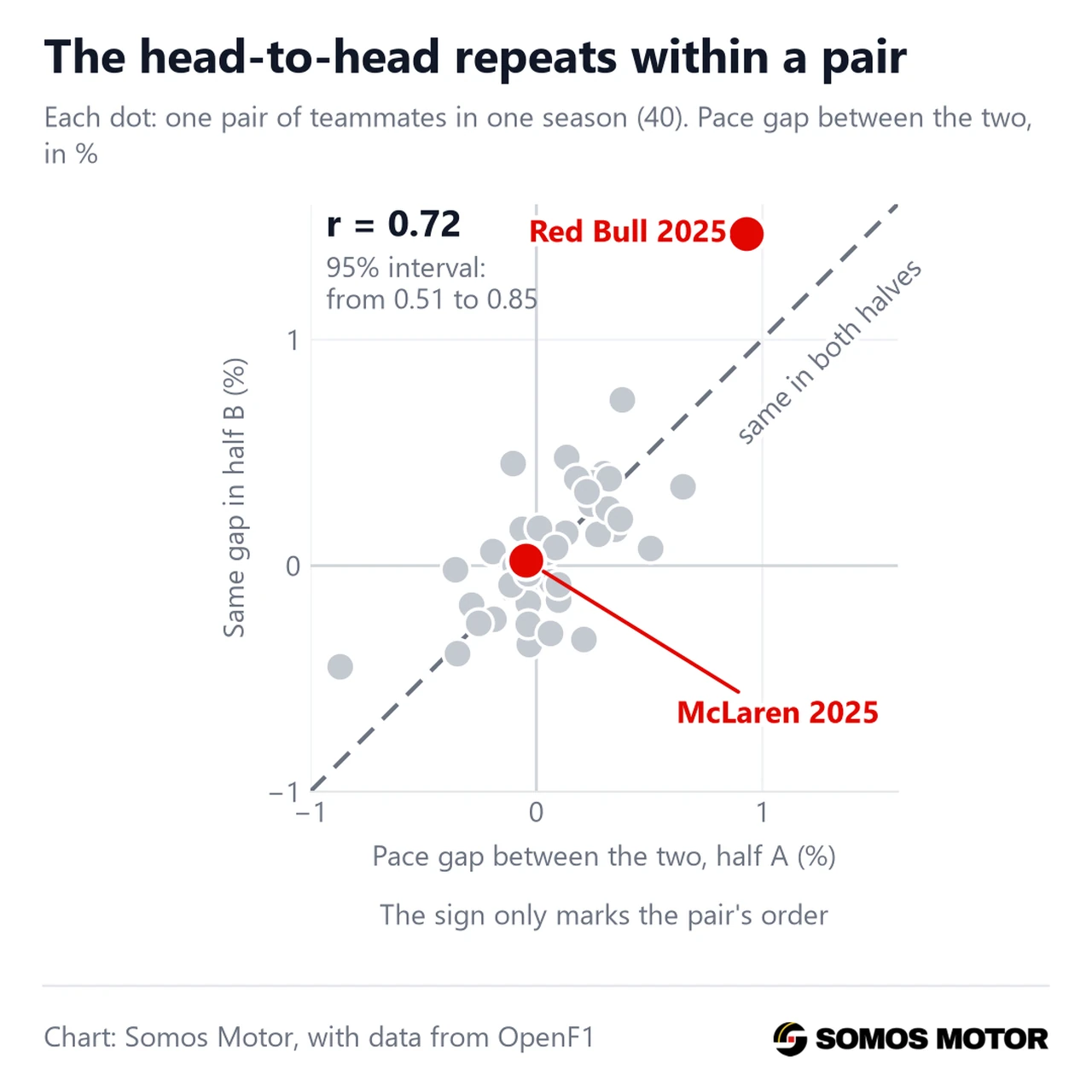
Once a pair has a gap, it keeps it. At Red Bull in 2025, Max Verstappen was quicker than Yuki Tsunoda in all 17 comparable races, the biggest pace gap of the 44 pairings with a figure. At the other end, Lando Norris and Oscar Piastri could not be separated over 19 races at McLaren: eight for one, eleven for the other, a median gap of 0.00%. In the first chart each dot is a pair, and the two halves of a season mostly land near the diagonal.
02Change the teammate and the picture blurs
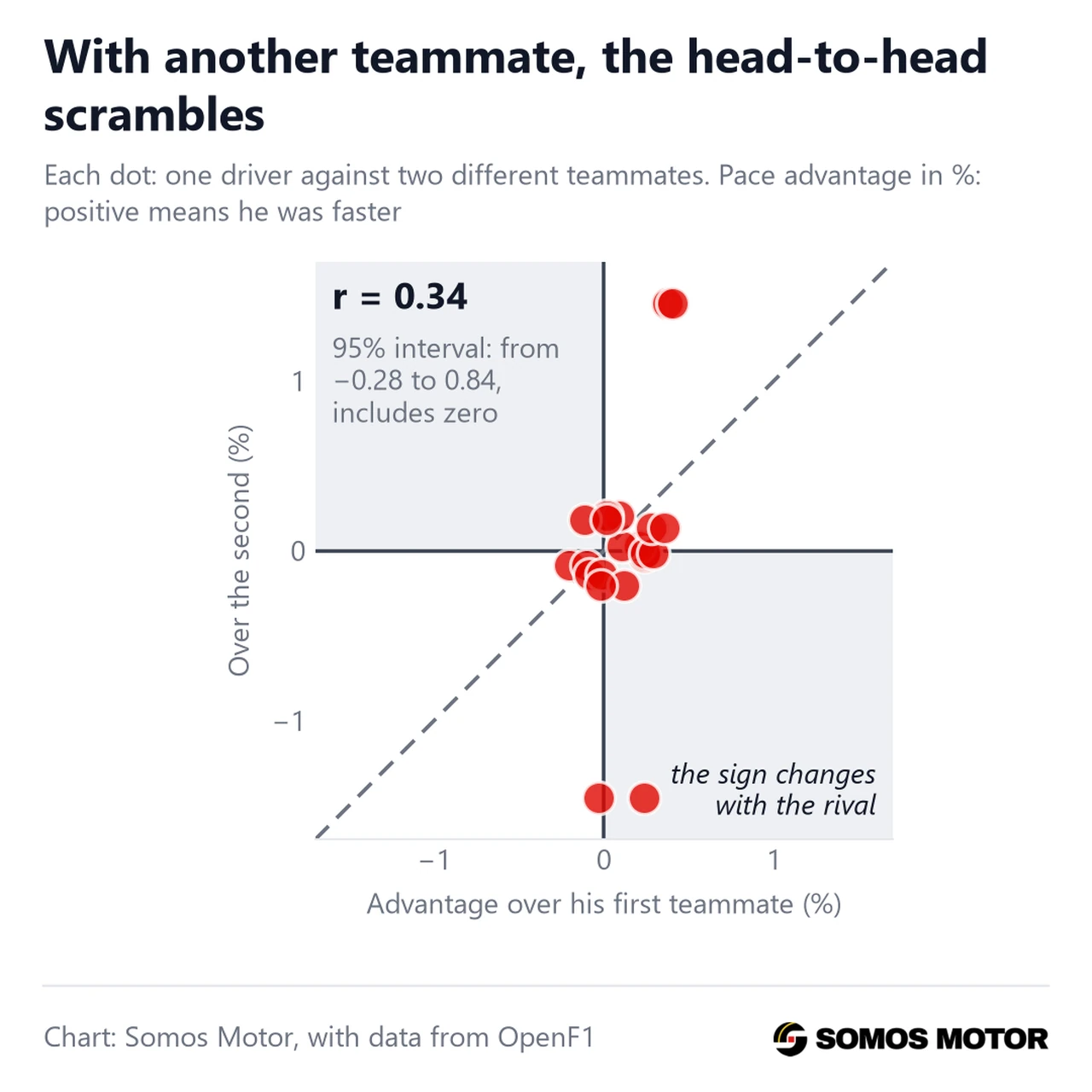
The test that matters is what happens when the same driver gets a new rival. Take Hamilton. In 2024, at Mercedes beside George Russell, the pair could not be told apart on race pace. In 2025, at Ferrari, Leclerc was clearly ahead of him. New team, new car, new partner: the data cannot say how much of that comes from each.
Others tell the same tale. Tsunoda was level with Daniel Ricciardo at RB in 2024, then 1.46% behind Verstappen at Red Bull in 2025. Nico Hülkenberg went from clearly quicker than Kevin Magnussen at Haas to level with Gabriel Bortoleto at Kick Sauber.
Big gaps show up against both rivals: Verstappen was clearly ahead of both Sergio Pérez and Tsunoda. Whether that follows the driver or the car, the data cannot say. For the smaller gaps, which are most of them, it cannot be shown that they carry over from one rival to the next.
The correlation runs from 0 (no resemblance) to 1 (identical), with its 95% interval in brackets.
| Duel | Between halves of a season | Same driver, new teammate |
|---|---|---|
| Qualifying | 0.71 (0.61 to 0.81) | 0.26 (−0.16 to 0.75) |
| Race pace | 0.72 (0.51 to 0.85) | 0.34 (−0.28 to 0.84) |
| Finishing order | 0.69 (0.55 to 0.78) | 0.29 (−0.21 to 0.75) |
What repeats is the pairing. That it travels with the driver is something the data do not show.
03How many races it takes to split two drivers
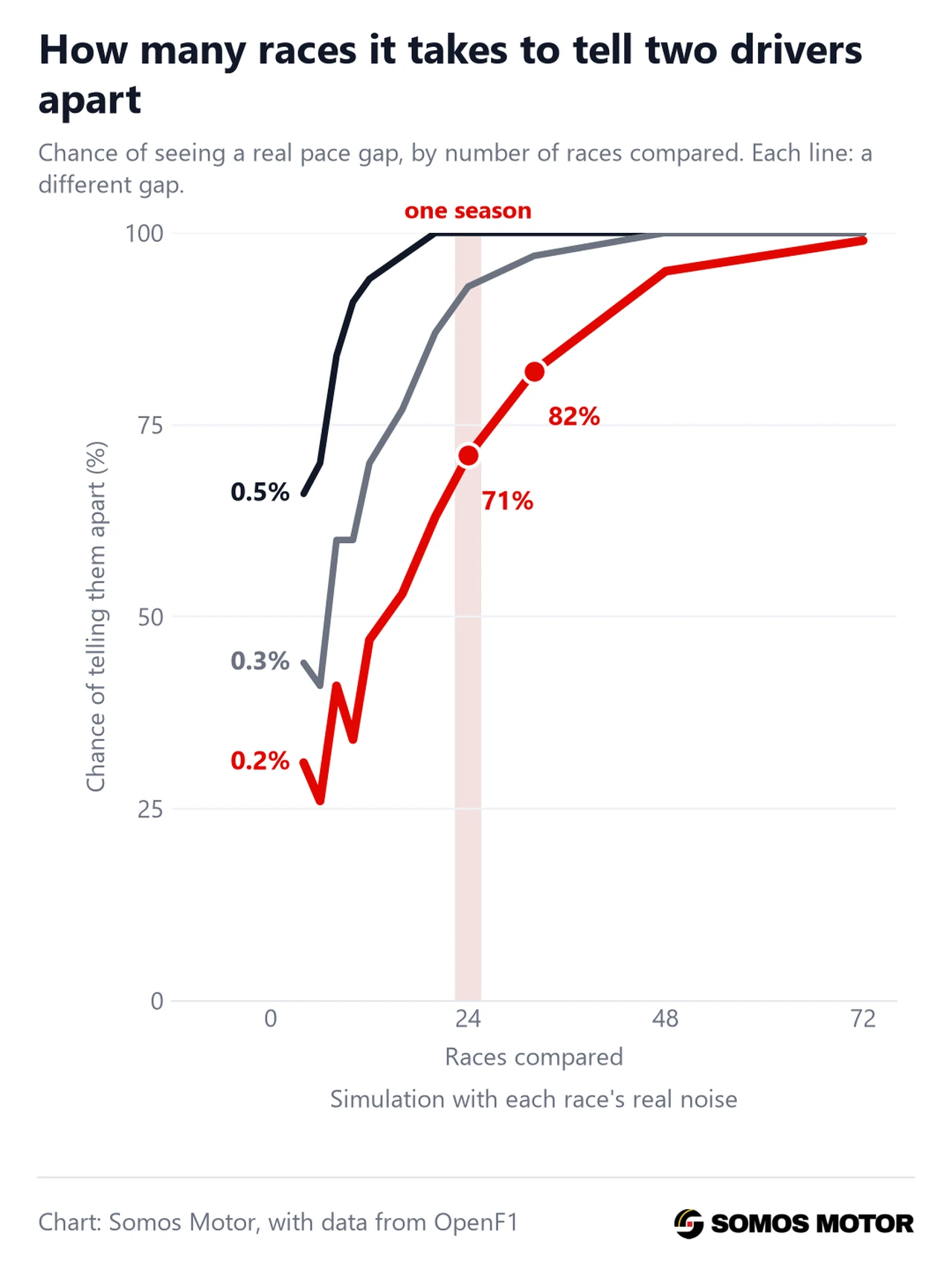
A season is about 24 races, and that is not enough to separate two similar drivers. With 24 races, a real gap of 0.2%, nearly two tenths of a second on a 90-second lap, would be told from a tie 71% of the time. With 32 races it is 82%, and with 48 it is 95%. A gap of 0.5% shows up in 10 to 12 races.
That is why only 16 of the 44 pairings with a figure show a clear gap. In the other 28, the pair is level or there are too few races to see it.
04Russell, two partners, no clear gap
George Russell is the mirror case. Beside Hamilton in 2024 he was level on race pace. Beside Kimi Antonelli in 2025 he was a shade ahead, by 0.18% over 19 races, but a tie still fits inside the interval. Neither year shows a clear gap, so both Mercedes pairings were close and little more can be said.
052026 gets its own count
The new regulations are counted apart: a different car and different tyres, and the new-partner test is run inside each rulebook. There are 15 pairings in 2026, 11 of them with a figure, and the season is still open, with Las Vegas, Qatar and Abu Dhabi to come. The 11 are recalculated once it closes.
06What is behind the measure
The data come from OpenF1 and run to 18 November 2026. A pair is two drivers at the same team in the same season; stand-ins and mid-season changes form separate pairs, and with fewer than six races there is no figure.
Three measures are used: the last qualifying stage in which both set a representative lap, race pace on clean laps against the median of the other cars (traffic is not corrected), and who finishes ahead. Wet races are left out. If you are starting from scratch, read how Formula 1 works and the F1 glossary.
There is no ranking of drivers. Pairs are islands, joined only by the drivers who change team, and each figure describes that pair in that season, not the driver. Come back after Abu Dhabi and see which of these gaps survive.
Frequently asked questions
Who beats their teammate in F1?
It depends on the pairing and the season. Of 44 pairings with a figure, 16 show a clear gap and 28 cannot be told from a tie. There is no ranking of drivers: pairs are islands, joined only by the drivers who change team.
Does beating your teammate prove anything in F1?
Not much beyond the pairing. The duel repeats inside a pair (0.69 to 0.72), but with a new teammate it falls to between 0.26 and 0.34, and the interval includes zero. Car, set-up and rival all play a part, and they cannot be separated from what the driver adds.
Norris v Piastri: is there a race pace gap?
Not one you could tell from a tie. At McLaren in 2025 they were level over 19 comparable races: eight for Norris, eleven for Piastri, and a median gap of 0.00%. Sainz and Leclerc at Ferrari in 2024 were just as close, with a median of 0.02% over 19 races.
How many races does it take to compare two F1 drivers?
For a real gap of 0.2%, about 32 races: with 24 it is told from a tie 71% of the time, with 32 it is 82%. A gap of 0.5% needs only 10 to 12.
How is the teammate head to head measured?
Three ways: the last qualifying stage in which both set a representative lap, race pace on clean laps against the median of the other cars, and who finishes ahead. Wet races and pairings of fewer than six races are left out.
Keep reading
More from the blog

November 23, 2026
Red Bull has lost its F1 pit lane crown
Red Bull was quickest through the pit lane in 2023 and 2024, then slipped back to the pack in 2025. Who took the crown, and who is stuck behind the median every year?

November 22, 2026
Ollie Bearman still unsigned at Haas as the F1 2027 grid takes shape
Haas insists Ollie Bearman will race for them in 2027, but there is still no signed contract. Here is where every other seat on the F1 2027 grid stands.

November 22, 2026
Perez gets five-place grid penalty for Qatar GP
The stewards found Sergio Perez wholly to blame for the Las Vegas clash with Rafael Camara. His unserved 10 seconds become a grid drop in Qatar.